9 Fixes for Clicks But No Calls
Fix a dumpster rental website that gets clicks but no calls, with 9 conversion changes for quotes, calls, and bookings. Get a free audit.
By Alex · Published Oct 24, 2026 · Updated Nov 4, 2026 · 11 min read

The Direct Answer
If your dumpster rental website gets clicks but no calls, the problem is usually not your ranking. It is your conversion path. Visitors arrive ready to book, but they cannot quickly see a phone number, understand what size they need, get a clear price direction, or complete a short quote form — so they leave and call a competitor whose site makes booking easy. Fix the phone visibility, the headline, the size guidance, the price clarity, the form length, the mobile experience, the trust signals, the page speed, and the next step on every page. Those nine fixes, applied in order, turn the traffic you already have into calls, without needing more traffic first. This guide is for dumpster rental companies in the United States whose pages rank or get clicks, but whose phones stay quiet. It is about conversion, not about getting more impressions. For the service behind this advice, see dumpster rental SEO. Rankings bring visitors; conversion turns visitors into booked rentals.
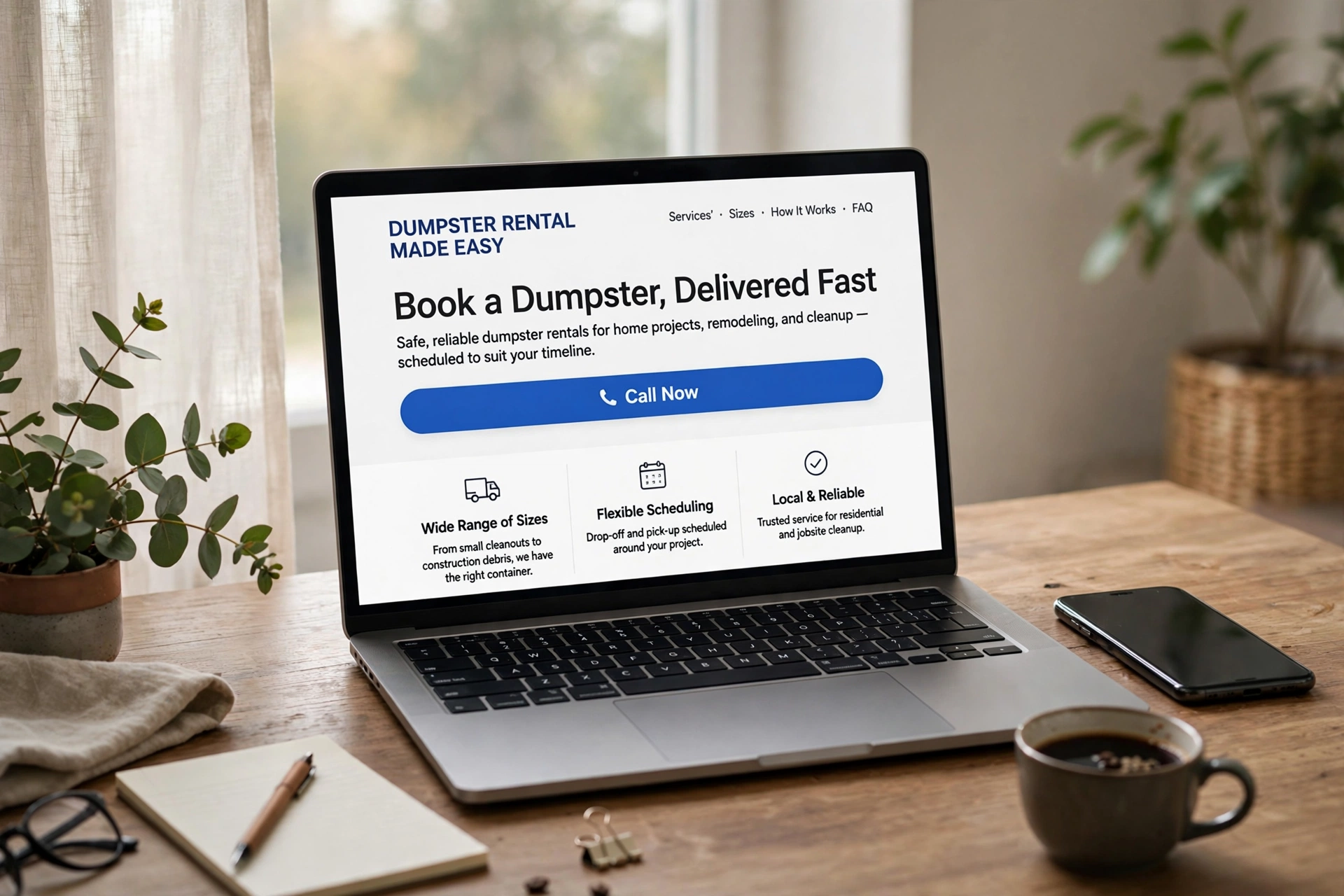
Fix 1: Make Your Phone Number Impossible to Miss
The most common conversion failure is also the simplest: the phone number is hidden. It is in a small font in the footer, or on a contact page the visitor never reaches, or it only appears after scrolling through a long hero section. On a dumpster rental site, the phone number should be visible at the top of every page, on desktop and on mobile, and it should be tap-to-call on a phone. A visitor who is standing in a driveway, ready to book, should not have to hunt for how to reach you. Test this on a real phone, not on a desktop preview. Open your homepage, your main service page, and a town page. On each one, can you see and tap the phone number within seconds, without scrolling or opening a menu? If not, fix that first. Every other conversion fix matters less if the customer cannot call you.
Fix 2: Write a Headline That Matches the Search
A visitor who searched for “dumpster rental near me” and lands on a headline that says “Welcome to Our Website” or “Quality Service Since Forever” will leave. The headline does not match what they searched for, and it does not tell them they are in the right place. Your headline should name the service and the place, in plain language, and state the benefit. For a town page, that means the town and the service. For a service page, that means the service and the project type. For a homepage, that means the service and the service area. Follow the headline with a direct answer in the first paragraph: what you offer, who you serve, and what the visitor should do next. Do not make visitors read three paragraphs of company history before they learn whether you rent the size they need in their town. For how to structure the pages that sit behind a good headline, see dumpster rental near me SEO.
Fix 3: Help Visitors Choose a Size in Seconds
Container size confusion kills conversions. A customer who does not know whether they need a small, medium, or large container will either call a competitor who explains it clearly, or abandon the booking altogether. Give a simple size guide on every service and landing page. Use project examples, not just measurements. Explain, in general terms, what kind of project each size is typically used for: a small cleanout, a medium remodel, a large construction job. Use plain language, not industry jargon, and avoid pretending that one size fits every project. The guide does not need to be long. A short list, with a project example for each size, is more helpful than a long technical table that a first-time renter cannot understand. If a customer still is not sure, give them an easy way to ask: a short form field for project type, or a prompt to call for size advice. Clarity about size also reduces wasted calls. Customers who arrive with a realistic size in mind are more likely to book, and less likely to cancel when they learn the container is too small or too large for their project.
Fix 4: Be Clear About Price Direction
Many dumpster companies hide prices because prices vary by town, size, rental duration, and debris type. That variation is real, but hiding all price information does not help. It makes visitors assume the price will be high, or that getting a price will be difficult, so they leave. You do not need to publish a fixed price for every scenario to convert better. You can give price direction: explain what affects price, give a general range or starting guidance where you can do so honestly, and make it clear how to get an exact quote quickly. If you cannot publish prices, say how long a quote takes and what information you need to give one. The key is to remove uncertainty. A visitor who knows what to expect — and who knows that a quote takes minutes, not days — is far more likely to submit a form or call than a visitor who sees no price information at all and has to guess. Be honest about fees and limits in general terms, too. If weight limits, rental extensions, or prohibited items affect price, say so plainly. Surprises after booking damage reviews and repeat business far more than clear upfront guidance does.
Fix 5: Shorten Your Quote Form Ruthlessly
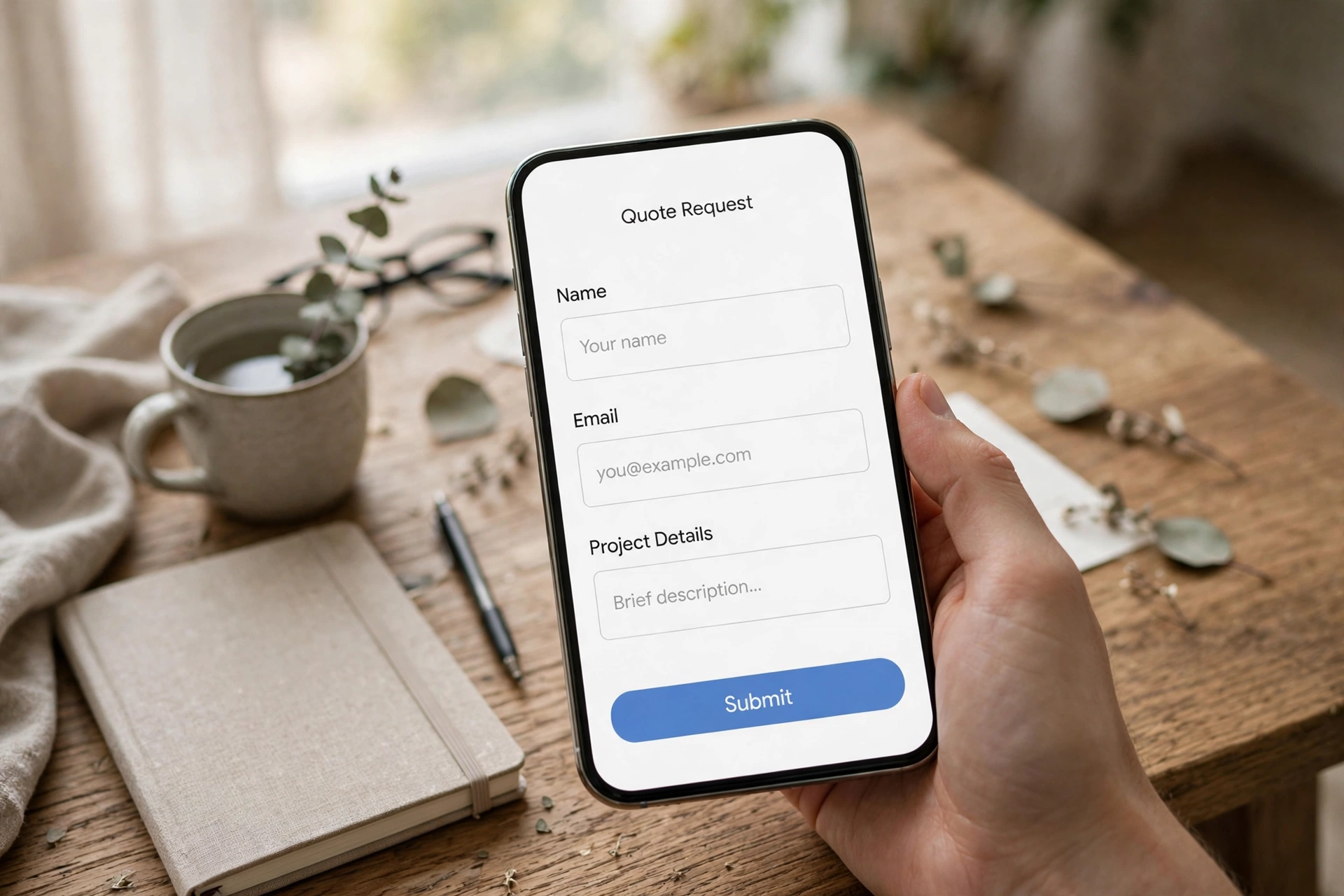
Every field on a quote form is a reason to abandon it. Long forms that ask for a full address, a detailed project description, a preferred delivery time window, a billing address, and a dozen other details before the customer has even received a price will lose most visitors. Ask only for what you need to give a price and make contact: name, phone number, town or ZIP code, container size or project type, and approximate delivery date if known. That is enough to start a conversation. You can collect the rest — exact address, placement details, debris type — after the customer has already contacted you and is engaged. Place the form where visitors expect it: near the top of a landing page, after the size guide, and again at the bottom of the page. Do not hide it behind multiple clicks, and do not make it the only way to contact you. Some customers prefer to call, and they should be able to do so from every page. Test the form yourself on a phone. If it takes more than a minute to complete, or if it is difficult to type into on a small screen, shorten it. A form that is easy to complete on a phone will outperform a detailed form that is only easy on a desktop.
Fix 6: Fix Mobile Before You Fix Anything Else
Most dumpster rental searches happen on a phone, often on a job site or in a driveway. If your site is designed for desktop and merely shrunk to fit a phone, it will fail at the moment that matters most. Check your site on a real phone for the basics: Is text readable without zooming? Are buttons large enough to tap without hitting the wrong one? Does the phone number tap to call? Does the form work without horizontal scrolling? Does the page load quickly on a mobile connection? Remove anything that gets in the way on mobile: large images that slow loading, pop-ups that cover the phone number or form, and navigation menus that require multiple taps to reach a service page. A mobile visitor should be able to go from search to call or quote in a few taps, not a maze. Mobile conversion is not a separate project. It is the main conversion project for a local service business. If your mobile experience is poor, your rankings and your advertising will both underperform, because the traffic you pay for or rank for will not convert.
Fix 7: Show Trust Before You Ask for a Booking
A dumpster rental is a trust decision. A customer is inviting a truck and a heavy container onto their property, and they want to know the company is real, reliable, and professional. If your site shows no proof, they will choose a competitor who does. Show trust signals near the top of landing pages, not just on a testimonials page no one visits. Recent Google reviews, with a link to read more, are the strongest signal for most local customers. Photos of real trucks, containers, and completed projects are next. Clear information about your service area, delivery process, and what happens after booking also builds trust. Do not use stock photos and pretend they are yours, or publish reviews you cannot substantiate. Real, recent, specific proof beats polished, generic claims. For how to build a review system that generates that proof consistently, see the review sections in dumpster rental marketing.
Fix 8: Speed Up Your Pages
Speed is a conversion factor, not just a technical metric. A page that takes a long time to load on a phone will lose visitors before they ever see your phone number or form, no matter how good your headline or offer is. Start with images. Large, uncompressed photos are the most common cause of slow local business pages. Compress images, use appropriate sizes for mobile, and remove images that do not help a customer decide or book. A dumpster rental page does not need a gallery of decorative images. It needs a few clear, relevant photos and fast loading. Next, remove unnecessary scripts, plugins, and animations that do not help conversion. Every extra element adds load time and another potential point of failure. Keep the page focused: headline, size guide, price direction, trust signals, phone number, and form. That focus is faster and more persuasive than a feature-heavy page. Test speed on a mobile connection, not just on fast office Wi-Fi.
Fix 9: Give Every Page One Clear Next Step
A page with five different calls to action — call, email, chat, download a guide, follow on social media, and fill out a long form — gives the visitor no clear next step. They hesitate, and hesitation leads to leaving. Give each landing page one primary next step, and make it obvious. For most dumpster rental pages, that step is either call now or get a quote. Secondary options, such as reading a related service page, should be clearly secondary, not competing with the primary action. Repeat the primary next step at the top, in the middle after the size guide or price direction, and at the bottom of the page. A visitor who is convinced halfway down the page should not have to scroll back to the top to call. A visitor who reads to the bottom should find the same clear action waiting for them. This clarity also helps you measure what works. If every page has one primary action, you can see which pages generate calls and quotes.
How to Prioritise the Nine Fixes
If you can only fix three things this week, fix phone visibility, form length, and mobile experience. Those three alone often account for most of the gap between clicks and calls, because they remove the biggest barriers to contact. Next, fix headline match, size guidance, and price direction. Those three improve the visitor’s confidence that they are in the right place and that booking will be straightforward. Finally, add trust signals, speed improvements, and a single clear next step on every page. Those three polish a conversion path that already works, rather than trying to polish a path that is broken at the first step. Track the result by calls and quote submissions, not by traffic alone. If calls rise while traffic stays the same, your conversion fixes are working. If traffic rises but calls do not, you still have a conversion problem, and you should return to this list before spending more on traffic.
Frequently asked questions
Why do I get clicks but no calls if I rank well? Ranking brings visitors, but conversion turns visitors into callers. If your phone number is hard to find, your headline does not match the search, your size guide is unclear, or your form is too long, visitors will leave even though they found you. Fix the conversion path before assuming you need more traffic. Should my landing page be different from my homepage? Yes. A landing page should be focused on one service and one town or service area, with one primary next step. A homepage has to introduce your whole business. A visitor who searched for a specific service in a specific town will convert better on a specific landing page than on a general homepage. How short should a dumpster rental quote form be? Short enough to complete on a phone in under a minute. Name, phone, town or ZIP code, size or project type, and approximate delivery date are usually enough to start. Collect detailed placement and billing information after the customer has already contacted you. Do I need to publish exact prices to convert? No, but you need to give price direction and a fast way to get an exact quote. Explain what affects price, give general guidance where you can do so honestly, and make the quote process quick and clear. Hiding all price information creates uncertainty, and uncertainty loses bookings. How do I know which fix matters most for my site? Test it as a customer on a phone. Try to call, try to get a quote, and try to choose a size, without any prior knowledge of your site. The places where you hesitate, scroll, or get confused are the places your customers hesitate too. Fix those first, then measure calls and quote submissions.
What to Do Next
Audit your top three pages today: your homepage, your main service page, and your best town page. On each one, check the nine fixes in order, on a real phone. Write down every barrier you find, fix the phone, form, and mobile issues first, and then work through the rest. Traffic you already have is the cheapest traffic you will ever get. Converting it better is usually faster and more profitable than buying or ranking for more traffic that will face the same barriers. If you would like help auditing your conversion path, request your free audit. We will review your pages as a customer would, identify where calls are being lost, and show you the fixes that will matter most for your market.
Tags
- #dumpster rental website conversion
- #dumpster rental clicks no calls
- #dumpster rental landing page
- #dumpster rental quote form