Dumpster Rental Marketing That Ranks Locally
Dumpster rental marketing with one page per town and one page per service, the exact structure that ranks and brings calls.
By Digital Rank Solutions Team · Published Oct 14, 2026 · Updated Nov 4, 2026 · 12 min read
The Direct Answer
The structure that ranks for dumpster rental marketing is simple: one page for each service you offer, one page for each town you actually serve, and a clear hub page that links them together. A homepage alone cannot rank for every service in every town, and a single “services” page that lists everything in one paragraph cannot match a specific search. Specific pages match specific searches, and specific searches turn into calls. If you build that structure well — with real, specific content on each page, a consistent service area, and a clear path to a quote — you give Google a page to rank for almost every high-intent search in your market. If you build it poorly, by copying the same page and changing only the town name, you will create thin pages that help no one. This guide gives you the exact structure, page by page, so you can build it correctly the first time. For the service that sits behind this structure, see Dumpster Rental SEO. The marketing structure below is how that service is organised for clients, explained so you can audit or build your own version.
Why One Page Per Service and Per Town Works
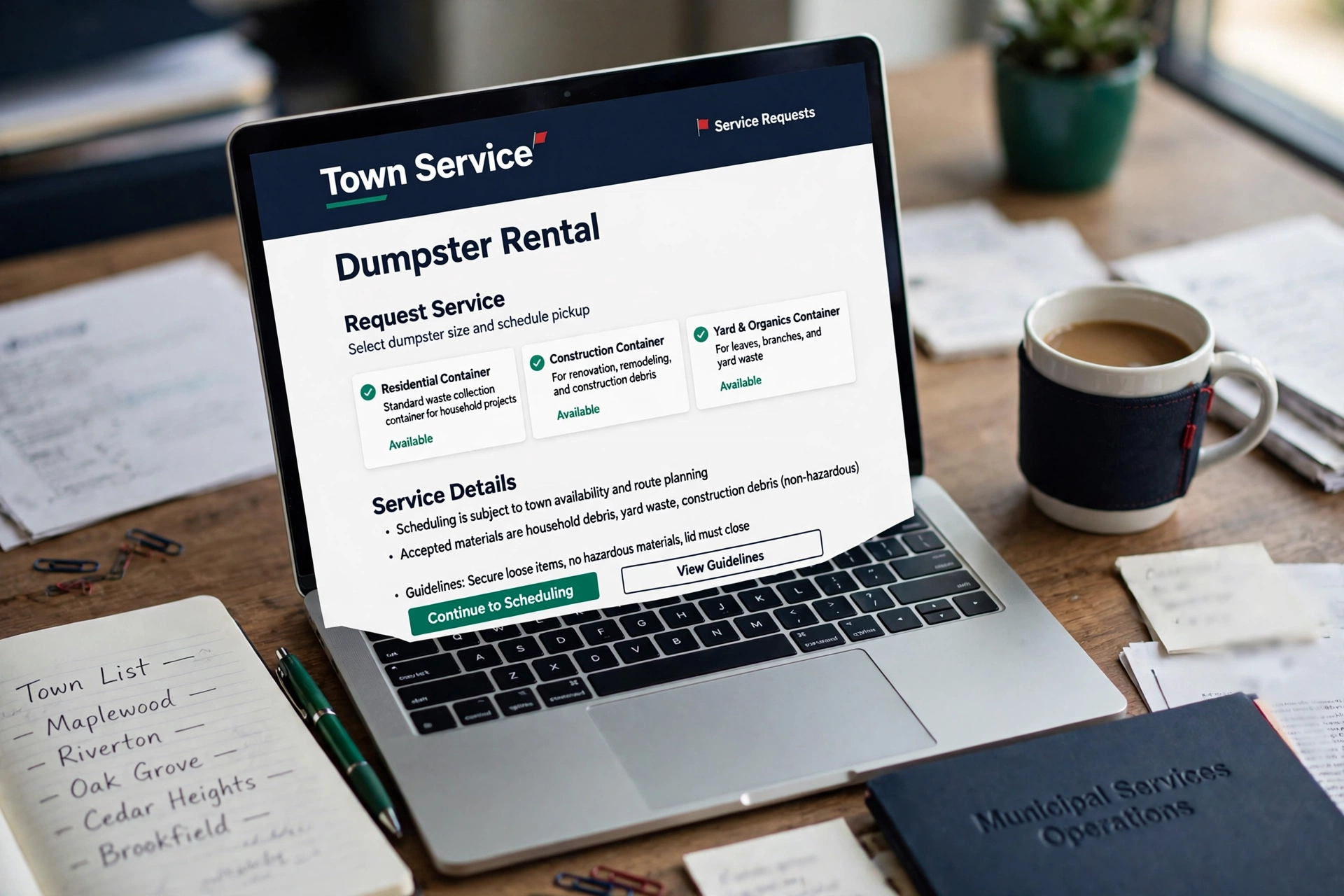
Think about how a customer searches. A homeowner in a suburb who is cleaning out a garage does not search for “waste management solutions.” They search for a dumpster rental in their town, for a cleanout, in a size that fits their project. A roofing contractor does not search the same way. They search for a construction or roofing dumpster, for a job site, with fast swap-outs. Google matches queries to pages. When a query is specific — service plus town, or service plus project type — a specific page is a better match than a general page. That is why one page per service and one page per town works: it creates a match for the query, rather than forcing Google to guess which part of a general page is relevant. It also helps customers. A visitor who lands on a page for their exact service and town immediately knows they are in the right place. They do not have to scroll through services they do not need, or wonder whether you serve their area. That confidence is what turns a visit into a call. The third benefit is internal linking. When service pages link to town pages, town pages link to service pages, and both link to the hub, Google can see how your site is organised. That structure distributes authority across your site — the link juice, in Neil Patel terms — instead of concentrating it all on a homepage that cannot rank for everything.
The Hub Page: Your Main Dumpster Rental Page
Every structure needs a hub. For dumpster rental, the hub is your main dumpster rental service page. It should explain, in plain language, what you offer, who you serve, what sizes are available, and how booking works. It should not try to be a page for every town or every project type. Its job is to introduce your business and guide visitors to the right specific page. A good hub page includes a clear headline that names the service, a direct answer to what you do, a list of your core services with a short description and a link to each service page, a list of your main service towns with a link to each town page, and a clear call to action to get a quote or call. It should also include trust signals: recent reviews, photos of real work, and clear information about delivery, rental periods, and what can and cannot go in a container. Trust signals do not replace specific pages, but they make the hub more credible for visitors who arrive there first. Do not overload the hub. If it becomes a long list of every town and every service with no depth, it stops being a hub and becomes a directory. Keep it focused, link out to the specific pages, and let those pages do the detailed work.
Service Pages: How to Build Each One
A service page should answer everything a customer for that service needs to know before they call. Start with the service name in the title and the main heading, in natural language. Then answer the core questions in the first few paragraphs: what is this service for, who is it for, what sizes are available, and how does booking work? Next, cover the practical details. For residential dumpster rental, that means project types, container sizes, driveway considerations, rental duration, and what fits in each size. For construction dumpster rental, it means job-site delivery, swap-outs, weight limits in general terms, and commercial booking. For roofing dumpster rental, it means roofing debris, placement on a job site, and timing around a roofing project. For cleanout dumpster rental, it means estate, garage, and yard cleanouts, and what to do with items that cannot go in a container. Each service page should also include a frequently asked questions section for that service. The questions should be the ones customers actually ask, not generic questions invented for SEO. If customers repeatedly ask about permits, prohibited items, or rental extensions, answer those questions on the relevant service page, in clear language. Finally, each service page should link to your town pages, especially the towns where that service is most requested, and to your quote or contact page. A visitor who is ready to book should never have to search for how to contact you. A common mistake is to create service pages that are identical except for the service name. If your residential, construction, and roofing pages all say the same thing, they are not really service pages. They are copies. Write each one for its actual customer, with examples and details that only apply to that service.
Town Pages: How to Build Each One Without Creating Thin Content
Town pages are the most powerful and the most abused part of dumpster rental marketing. Done well, they rank for the exact searches that generate calls in that town. Done poorly, they are copied pages that Google recognises as thin and that customers recognise as unhelpful. A good town page starts with the town name in the title and headings, but it does not stop there. It should describe the town in terms relevant to dumpster rental: the types of projects common there, the neighbourhoods or areas you serve, and the services most requested there. If you serve a suburb known for new subdivisions, talk about construction and remodel projects. If you serve an older suburb, talk about cleanouts, renovations, and roofing replacements. That specificity is what makes the page useful. Include practical local information: delivery areas within the town, any general placement considerations, and how to get a price for that town. Do not invent local facts you do not know, such as specific permit rules, unless you have verified them. It is better to give general, accurate guidance and invite the customer to confirm details when they call, than to publish a specific claim that turns out to be wrong. Add local proof where you have it. Reviews from customers in that town, photos from projects in that town, and mentions of real neighbourhoods all make a town page credible. If you do not yet have local proof for a town, that is a sign to focus on building it — through reviews and completed jobs — before you expect the page to rank strongly. For an example of how to think about a metro and its suburbs as a cluster, read How to Rank in Dallas-Fort Worth for Dumpster Rental: A Real Market Breakdown. The principle is the same in any market: a metro hub, suburb pages, and service pages that link together.
The Linking Structure: How Link Juice Should Flow
Linking is not an afterthought. It is how authority flows through your site, and how Google and visitors navigate from a general query to a specific booking page. Use this simple structure. Your hub page links to every service page and to your main town pages. Every service page links back to the hub, to related service pages, and to the town pages where that service is offered. Every town page links back to the hub, to the service pages most relevant in that town, and to your quote page. Your blog posts link to the service or town page they are most relevant to, not just to your homepage. Use natural anchor text. Instead of linking the words “click here,” link a phrase that describes the destination, such as “residential dumpster rental” or “dumpster rental in Plano.” That helps both readers and search engines understand where the link goes. Do not stuff keywords into every link. One clear, descriptive link per relevant mention is enough. Avoid orphan pages. Every page on your site should be reachable by at least one link from another page on your site, ideally from a hub or a related service or town page. A page with no inbound links is hard for Google to find and hard for customers to reach, no matter how well it is written. This structure also helps you avoid cannibalisation. When each page has a clear primary topic — one service, or one town — and links to related pages rather than competing with them, Google can rank the right page for the right query. When two pages target the same topic with the same content, they compete with each other and neither ranks as well as it should.
What Goes on a Roll-Off Dumpster Page Specifically
Roll-off dumpster SEO deserves special attention because “roll-off” is the term many contractors and experienced homeowners use, while others simply search for “dumpster rental.” A roll-off page should explain what a roll-off container is, in plain language, how it is delivered and picked up, and what sizes are typically used for different projects. Do not assume every visitor knows the terminology. Explain that a roll-off container is delivered by truck, rolled off onto a driveway or job site, loaded by the customer, and then picked up by the truck. That simple explanation builds trust with first-time renters and shows contractors that you understand the logistics. The roll-off page should also link to your service pages for residential, construction, and roofing work, and to your town pages. A customer who searches for “roll-off dumpster” is often ready to book, so the path to a quote should be short and obvious.
How Many Pages Do You Actually Need to Start?
Start smaller than you think, and build well. A strong starting structure for a single-location dumpster company is: one hub page, four to six service pages, and five to ten town pages for your core service area. That is roughly ten to seventeen pages, each specific and useful, rather than fifty thin pages. Build the hub and service pages first, because they define what you offer. Then build town pages for the towns where you already have customers, reviews, and profitable delivery routes. Those pages will have the most local proof and the best chance to rank quickly. Expand only when you can maintain quality. Each new town page should have real local specificity, not just a swapped town name. Each new service page should have a real customer in mind, not just a keyword you want to target. Growth in local SEO comes from depth in your real market, not from breadth across markets you do not serve. If you are unsure which towns to start with, look at your recent bookings. The towns where you already deliver, where customers already review you, and where delivery is profitable are your starting cluster. Build those pages first, and let the data from calls and bookings guide your next expansion.
Common Structure Mistakes to Avoid
The first mistake is the copy-and-paste town page. If you can replace the town name on a page and it still reads exactly the same, it is not a town page. It is a template. The second mistake is the mega-service page. A single page that tries to cover residential, construction, roofing, commercial, and cleanout work in one long list will rank poorly for all of them, because it is not specific enough for any of them. The third mistake is linking everything to the homepage. Internal links should guide visitors to the most relevant specific page, not back to a general page they have already seen. Link to the service or town page that answers the visitor’s next question. The fourth mistake is creating pages for towns you do not serve. That wastes effort, creates misleading content, and can lead to calls you cannot fulfil profitably. Serve a town well, or do not target it yet. The fifth mistake is neglecting the hub. If your hub is outdated, your service and town pages will still work, but visitors who arrive at the hub will not know where to go next. Keep the hub current, with links to your best service and town pages.
Frequently Asked Questions
How many town pages should a dumpster company have? As many as you can make genuinely specific and useful, starting with your core service area. For most single-location companies, five to ten excellent town pages are a stronger start than fifty thin ones. Expand as you gain customers, reviews, and local proof in new towns. Should service pages and town pages link to each other? Yes. Service pages should link to town pages where that service is offered, and town pages should link to service pages relevant in that town. That cross-linking helps Google understand your structure and helps visitors move from a general service to a local booking page. What is the difference between a service page and a blog post? A service page is a permanent page that describes a service you offer and is designed to convert visitors into calls or quotes. A blog post is usually informational, answers a specific question, and links to a service page. Blog posts support service pages; they do not replace them. Can I use the same content on a town page and a service page? No, not in full. Town and service pages should each have unique content focused on their primary topic. They can share general information about booking or container sizes in brief form, but the main content should be specific to the town or the service, otherwise the pages will compete with each other. How do I know if my structure is working? Track rankings and calls by town and by service, not just overall traffic. If a town page ranks and generates calls from that town, it is working. If a service page ranks for its service but generates no calls, check its conversion path — phone visibility, quote form length, and clarity of pricing guidance.
What to Do Next
Audit your current structure before you build more. List your service pages and town pages, check which ones are specific and which ones are copies, and check whether every page is linked from a hub or a related page. The gaps in that audit are your building plan. Then build in order: hub, service pages, core town pages, and internal links between them. Do not add new towns until your core pages are excellent. Local SEO rewards a clear, specific structure more than a large, vague one. For the broader playbook that this structure sits inside, see How to Rank #1 for “Dumpster Rental Near Me” in Your Town: The Complete Local SEO Playbook. And if you would like help building this structure for your market, request your free audit. We will review your current pages, your service area, and your rankings, and show you exactly which service and town pages to build first.