Local Services Ads vs Organic SEO
Compare Local Services Ads and organic SEO by real cost per booked job, and see when each one makes sense for home services.
By Digital Rank Solutions Team · Published Oct 20, 2026 · Updated Nov 4, 2026 · 10 min read
The direct answer
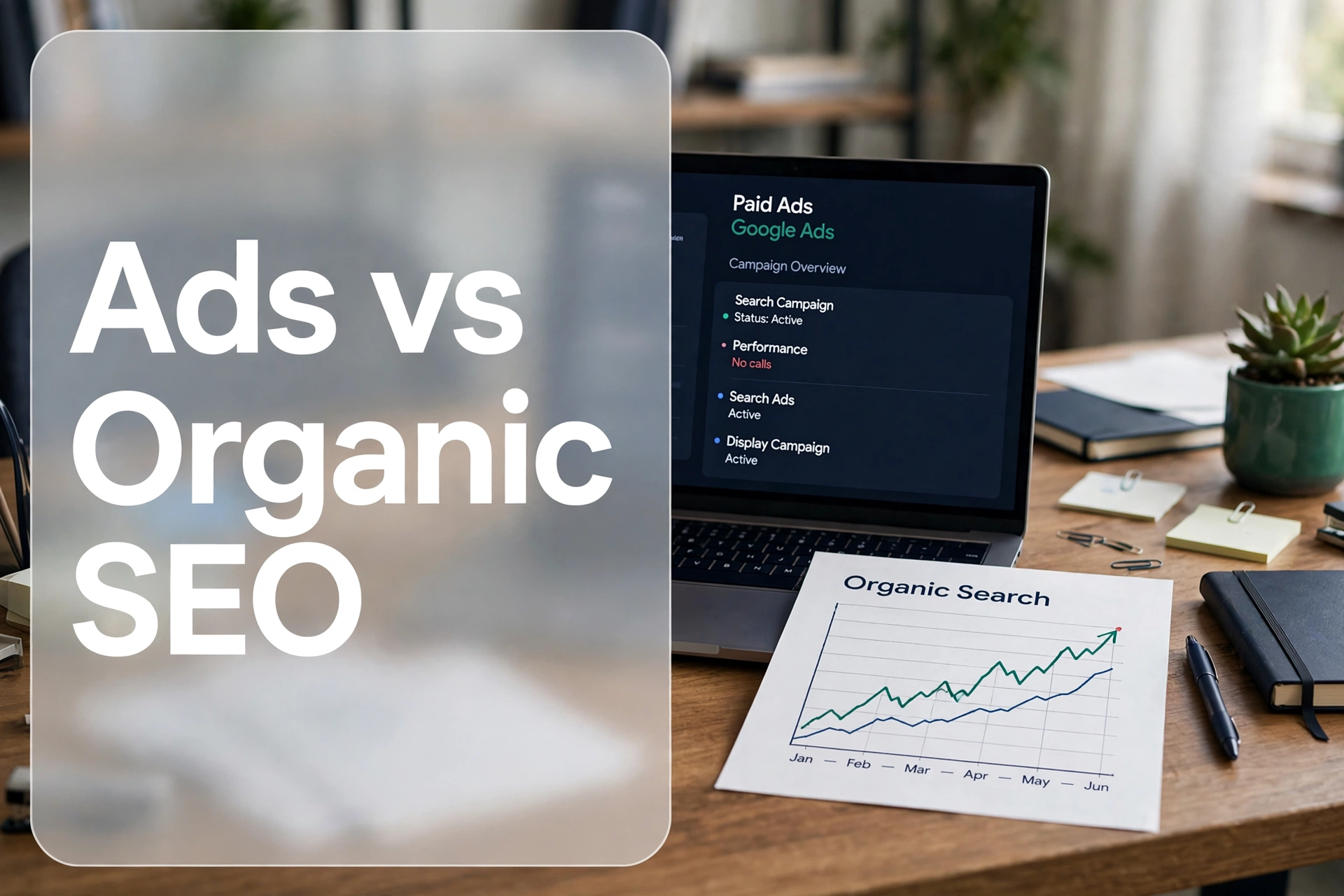
Local Services Ads can bring calls quickly, and organic SEO can bring calls at a lower cost per booked job over time, but neither one is automatically the right choice on its own. The honest comparison is not cost per click or cost per lead. It is cost per booked job, and how long that cost keeps working after you stop paying. For junk removal, the numbers in this guide tell the story clearly. Local Services Ads cost $19.85 per lead in 2025, rising to $33.14 per lead in 2026, an increase of 67%. Organic and directory leads cost $5 to $15 per lead, and $10 to $35 per booked job, compared with $45 to $110 per booked job from Local Services Ads, and $70 to $165 per booked job from search ads. That gap is why many home services companies use ads for immediate work, while building organic search to lower their long-term cost per job. This guide compares both channels, explains when each makes sense, and shows how to use them together without depending on paid leads forever. For the local foundation that makes organic work possible, see Google Business Profile for Home Services: The 2026 Setup That Actually Gets You Into the Map Pack at Google Business Profile for home services and How to Get More 5-Star Reviews (and Why 47% of Customers Won't Call You Without Them) at how to get Google reviews.
What Local Services Ads actually are
Local Services Ads, often called LSAs, are the Google ads that appear at the top of search results for local services, with a badge, a rating, and a phone number. A customer does not click through to your website first. They call directly from the ad, or they message through Google. You pay for leads, not for clicks in the traditional sense. That sounds simple, and in some ways it is. You set a budget, you set your service area, and Google shows your ad to customers searching for services like yours. When a customer calls, that is a lead, and you are charged for it, subject to Google's lead rules and dispute process. LSAs work best when you need calls now, have capacity to answer the phone, and can track which calls become booked jobs. Without that tracking, you will pay for leads without learning whether they were worth it. LSAs also depend on your Google Business Profile. Your rating, your reviews, and your business information affect whether customers choose your ad over the next one. A weak profile hurts paid ads just as much as it hurts organic search, because customers still compare ratings before they call.
What organic SEO actually is
Organic SEO is the work that helps your business appear in the regular, unpaid search results and in the Map Pack, without paying for each click or lead. It includes your Google Business Profile, your website pages, your reviews, and your content. Organic SEO does not work instantly. It builds over weeks and months, as Google learns that your business is real, relevant, and trusted in your area. That is why it is a long-term investment, not a quick fix. Organic SEO also works differently from ads: when you pause an ad, it stops showing, while a strong organic presence keeps bringing calls, often at a much lower cost per booked job. For junk removal, that long-term effect matters, because the same principles support our junk removal SEO approach: local SEO, a strong profile, reviews, and one page per service and town, so customers find you first when they search in your area.
The numbers, side by side
Here are the junk removal figures used throughout this guide, so you can compare them on the same basis: • Local Services Ads cost per lead: $19.85 in 2025, rising to $33.14 in 2026, an increase of 67%. • Organic and directory leads: $5 to $15 per lead. • Cost per booked job, organic and directory: $10 to $35. • Cost per booked job, Local Services Ads: $45 to $110. • Cost per booked job, search ads: $70 to $165. Read those numbers carefully. Cost per lead is not cost per booked job. A lead is a call or a message. A booked job is a customer who actually books and pays. If many leads do not book, the cost per booked job will be much higher than the cost per lead, even if the lead price looks reasonable. That distinction explains why organic can look modest on a lead basis, and even better on a booked-job basis. Organic customers often arrive with more information, because they have read your reviews, your service pages, and your profile before they call. That does not guarantee a booking, but it often means the call is more qualified. It also explains why a rising LSA lead price matters so much. When the lead price rises from $19.85 to $33.14, the cost per booked job rises too, unless your booking rate improves at the same time. If your booking rate stays the same, you pay more for the same number of jobs.
Why LSA costs are rising
LSA prices rise when more businesses compete for the same searches in the same area, and they vary by market: a competitive metro costs more than a smaller town. Your real cost depends on your area, your rating, your reviews, and how well you answer and book calls. If you build your whole lead flow on LSAs, you are exposed to price rises you do not control.
When Local Services Ads make sense
LSAs make sense in several clear situations: First, when you need calls now. If you have trucks, crews, or technicians available this week, and your organic presence is still building, LSAs can fill that gap. They are a short-term bridge, not a long-term replacement for organic work. Second, when you are entering a new area. If you have just expanded into a new town, LSAs can bring early calls while your local pages, reviews, and profile build up in that area. Third, when you can answer and book well. LSAs reward businesses that answer quickly, book efficiently, and follow up. If your phone is answered, your booking process is clear, and your team shows up on time, more LSA leads will become booked jobs, which lowers your effective cost per job. Fourth, when you track results properly. You should know, for each channel, how many calls you received, how many became booked jobs, and what each booked job cost. Without that tracking, you cannot tell whether LSAs are helping or hurting your margins. If you cannot answer quickly, or you do not track booked jobs, fix those problems before increasing your LSA budget.
When organic SEO makes sense
Organic SEO makes sense when you want lower long-term cost per booked job, steadier lead flow, and less dependence on ad prices. It makes sense when you serve a defined area and offer defined services, because that clarity lets you build pages and a profile that match real searches. It also makes sense when your customers research before they call. Many home services customers read reviews, check photos, and compare businesses before they contact anyone, so a strong profile and strong content help you win those comparisons. Organic SEO does not make sense as a promise of instant results. If someone promises you a top ranking by a fixed date, be cautious. Real organic growth takes time, and the timeline depends on your market, your competition, and your starting point. For a realistic timeline, see How Long Does SEO Take? The Honest Timeline for Local Businesses (Weeks, Not Promises) at how long does SEO take.

How to use both together, without depending on ads
The best approach for most home services companies is not ads or organic. It is ads for now, organic for the future, with a plan to shift the balance over time. Start with a clear budget split, based on your capacity and your current organic strength. If your organic presence is weak, you may need more ad spend at first to keep work flowing. As your profile, reviews, and pages improve, you can gradually reduce ad spend, or keep it steady while your total lead volume grows, which lowers your blended cost per booked job. Use ads to learn. Which services get the most calls? Which towns convert best? Which questions do customers ask before they book? Use those answers to build organic pages and content for the services and towns that actually convert, not just the services and towns that get the most clicks. Use organic to protect your margins. When organic brings a steady flow of calls at $10 to $35 per booked job, you are less exposed to an LSA price rise. When LSAs rise from $19.85 to $33.14 per lead, as they did for junk removal, a business with strong organic does not have to accept every price increase to keep working. It can choose where ads still make sense, and where organic already covers the demand. Track both channels on cost per booked job, and review that number monthly. If organic cost per booked job is falling while volume is steady or rising, your organic investment is working. If LSA cost per booked job is rising while volume is flat, improve booking, targeting, or profile strength, or reduce spend in that market.
Mistakes that make both channels more expensive
Avoid these mistakes, because they raise costs in both channels: • Paying for leads in towns you will not travel to, which wastes budget and creates bad experiences • Running ads with a weak profile, few reviews, or outdated hours, which makes customers choose the next ad • Measuring clicks instead of booked jobs, which hides the real cost of a channel • Stopping organic work when ads are working, which leaves you exposed when ad prices rise • Stopping ads too early, before organic has built enough volume to replace them • Copying a competitor's budget or keywords without checking whether those services and towns convert for you The cheapest channel is not always the best, and the fastest is not always the most profitable. The right channel brings booked jobs at a cost your margins can support, consistently, in the areas you actually serve.
A simple decision checklist
Before you increase spend in either channel, answer these questions honestly: • Can we answer calls quickly, and book efficiently, during the hours we claim to be open? • Do we know our cost per booked job for LSAs, for search ads, and for organic, separately? • Is our Google Business Profile complete, with recent reviews, real photos, and accurate services and areas? • Do we have service and town pages for the services and towns that actually convert? • Are we asking for reviews after every job, and responding to them? • If ad prices rose again next month, would we still have work from organic search? If you cannot answer yes to most of these, fix the basics first. Ads will amplify a weak foundation, but they will not fix it. Organic will reward a strong foundation, but it will not build it overnight.
Frequently asked questions
Should I stop Local Services Ads once organic starts working? Not necessarily, and not suddenly. Use organic growth to reduce your dependence on ads, not to cut them off in one step. Keep ads for services, towns, or times where organic does not yet cover demand, and reduce spend gradually as organic volume grows. A sudden stop can leave a gap if organic volume is not yet steady. Why is cost per booked job more important than cost per lead? Because a lead is not a job. A channel can look cheap per lead, but expensive per booked job, if many leads do not book. A channel can look more expensive per lead, but cheaper per booked job, if its leads book at a higher rate. Always compare channels on booked jobs, and on the revenue and margin from those jobs, not on leads alone. How do I know if my LSA budget is too high for my market? Compare your cost per booked job with your margin per job, and with your organic cost per booked job. If LSAs consistently cost $45 to $110 per booked job, as in the junk removal figures above, while organic costs $10 to $35, and your margins are tight, you may be over-reliant on LSAs. That does not mean LSAs are wrong. It means you need a plan to build organic volume in the same services and towns. What should I do first if I can only afford one channel this month? Fix your Google Business Profile and your review system first, because they help both channels. Then, if you need calls now, use a controlled LSA budget in your best-converting towns, while you start the organic pages and content that will lower your cost over time. Do not spend on ads with a weak profile, and do not expect organic to replace ads in a week.
Your next step
Work out your real numbers this week: for each channel, count calls, booked jobs, and total spend, and calculate your cost per booked job. That one number will tell you more than any dashboard. Then make a plan, not a guess: use ads where they still make sense, build organic where it lowers your cost, and track both on the same basis. If you want help working out those numbers, and building the organic pages, profile, and reviews that lower your cost per booked job, request a free audit. We will review your current channels, your profile, and your competitors, and show you where organic can replace paid leads first.