How to Get More 5-Star Reviews
A simple system to get more 5-star Google reviews for local businesses, and why reviews decide who gets the call first. Get a free audit.
By Digital Rank Solutions Team · Published Oct 31, 2026 · Updated Nov 4, 2026 · 9 min read

The direct answer
To get more Google reviews, ask every customer, shortly after the job, with a direct link, and make the request part of your normal finish, not a favour you remember once a month. That habit, repeated after every job, separates businesses with steady recent reviews from businesses with a quiet profile. Let us be precise about the number in the title. The research behind it does not say that 47% of customers will never call any business without reviews. It says that 47% of customers will not use a business with fewer than 20 reviews, based on earlier BrightLocal-based research. That is a threshold, not a general complaint about reviews. If you have fewer than 20 reviews, a large share of potential customers may pass you over before they ever call, no matter how good your work is. If you cross that threshold, and keep adding recent reviews, you remove a major reason to be skipped. Reviews also support your Google Business Profile. A complete profile with recent reviews looks active and trustworthy, while a profile with no recent reviews looks uncertain. For the full profile setup, see Google Business Profile for Home Services: The 2026 Setup That Actually Gets You Into the Map Pack at Google Business Profile for home services.

Why reviews decide the call
Customers for home services are not buying a product they can return easily. They are inviting someone into their home, or trusting someone with a garage door that will not close, a garage full of junk, or a dumpster on their driveway. That is a trust decision, made quickly. Reviews are the fastest trust signal available. A customer can read, in a minute, whether other people had a good experience, whether the company showed up on time, and whether problems were handled well. That matters more than a polished website, because reviews come from other customers, not from the company itself. Recent reviews matter as much as total reviews. A business with many old reviews, but nothing recent, looks like it may have changed, slowed down, or stopped serving the area. A business with steady recent reviews looks active, in demand, and current. If two businesses look similar on price and services, the one with more recent, detailed, positive reviews usually wins the call. This applies across home services, including junk removal SEO, where customers often book the same day and choose the first company they trust.
What counts as a good review
Not all reviews are equal. A short review that says only that the service was good is helpful. A detailed review is much more helpful, because it tells future customers what actually happened. A good review usually mentions the service, the area, and the experience. For example, a customer might say the team arrived on time for a garage cleanout, explained the price before starting, and left the driveway clean. That kind of detail answers the questions a future customer is already asking, and it helps Google understand what you do and where you do it. Do not write reviews for customers, do not copy the same text for different customers, and do not offer a reward in exchange for a positive review. Those practices damage trust, and they can create problems for your profile. Ask honestly, let customers write in their own words, and accept that not every review will be five stars. A profile with only perfect, identical reviews looks less believable than a profile with mostly positive reviews and thoughtful responses to the occasional problem. Crossing 20 reviews removes the threshold problem described above. After that, your goal is steady, recent, detailed reviews, not a race to an arbitrary total.
Step 1: Make asking part of finishing the job
The biggest reason businesses do not get reviews is not that customers refuse. It is that nobody asks, or asking happens too late. Build the ask into your finish, in this order: • Finish the job well, and walk the customer through what was done. • Confirm the price, the cleanup, and what happens next, so there are no surprises. • Ask, in person or by message, if they would be willing to leave a Google review about their experience. • Send the direct review link immediately, while the experience is fresh. Do not wait until the end of the week, or until you remember. A customer who had a great experience on Monday may have forgotten the details by Friday. A customer who receives a link within hours is far more likely to leave a review, and the review is likely to be more detailed. If your team does the work, train them to ask, and give them a simple script. The script should be short, polite, and honest. For example: “If you were happy with the work today, would you mind leaving us a Google review? It helps other homeowners in the area find us, and it only takes a minute. I will send you the link now.” That is enough. A long, awkward pitch makes customers uncomfortable and less likely to help.
Step 2: Send one link, not a search task
Never tell a customer to search for your business and find the review button. That adds steps, and every extra step loses people. Use your direct Google review link, and send it by the channel the customer already uses, whether that is text message or email. The message should be short, thank the customer, and include the link. Do not send multiple links, multiple reminders on the same day, or a long explanation of why reviews matter to your business. One clear message is enough. If a customer does not leave a review after the first message, one polite reminder a few days later is reasonable. After that, stop. Repeated reminders annoy customers, and annoyed customers do not leave positive reviews. Your system should be persistent across many customers, not pushy with one customer.
Step 3: Ask everyone, not just the happiest customers
It is tempting to ask only customers who seemed delighted, and to skip customers where the job was difficult. That creates a biased picture, and it misses an opportunity. Ask every customer, as a standard step, regardless of how smooth the job was. If a job went badly, fix the problem first, then ask. A customer whose problem was handled well may leave a review that is more convincing than a review from an easy job, because it shows how you respond when things go wrong.
Step 4: Respond to every review
Responding is part of getting reviews, not an optional extra. Future customers read your responses, and they judge your business by them. For positive reviews, thank the customer by name if they used their name, mention the service if appropriate, and keep it short. Do not copy the same response to every review. A personal, specific response shows that a real person read the review. For negative reviews, stay calm and professional. Do not argue in public, do not share private details, and do not blame the customer. Acknowledge the experience, apologise where it is fair to do so, and offer a way to resolve the problem offline, such as a phone call or email. Then follow through offline. A thoughtful public response to a negative review can increase trust, because it shows future customers that you take problems seriously. Respond promptly, ideally within a day or two. A review that sits unanswered for weeks looks ignored, even if the work itself was excellent.
Step 5: Make the system run itself
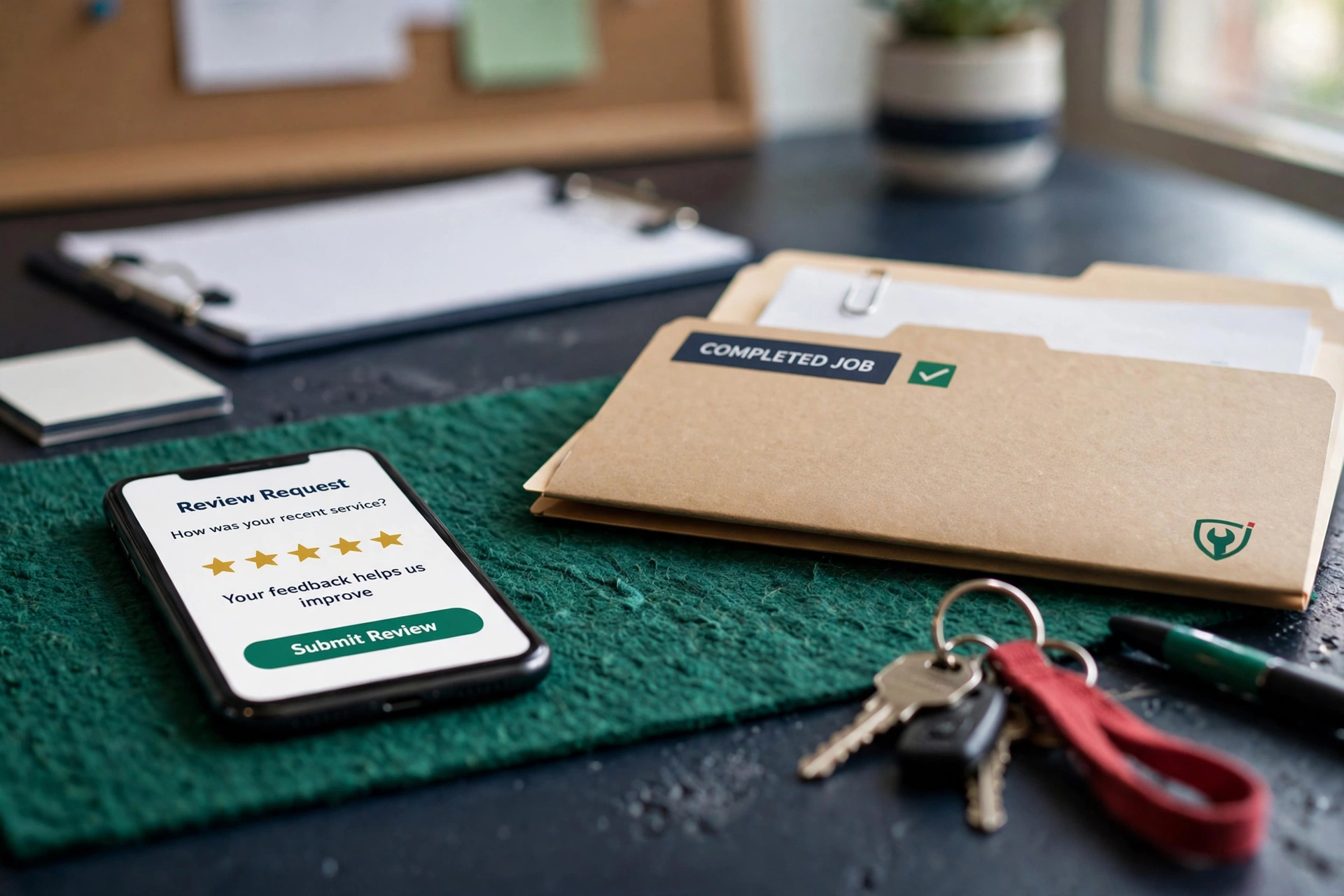
A review system that depends on memory will fail. A review system that runs itself will keep working, even on your busiest weeks. That is the subject of The 20-Review Rule: How to Build a Review System That Runs Itself at review system for local business. In short, the system has three parts: a trigger, a message, and a check. The trigger is the completion of a job. When a job is marked complete, the review request should go out, without waiting for someone to remember it. You do not need complex software to start. A simple checklist, used after every job, is a system. As you grow, you can automate the message, the reminder, and the follow-up, but the principle stays the same: every job, every time, one link, one reminder.
Mistakes that slow review growth
Avoid these common mistakes: • Asking only when you remember, instead of after every job • Sending customers to search for you, instead of sending a direct link • Offering a reward for a positive review, which damages trust • Ignoring negative reviews, which makes future customers assume you do not care • Copying the same response to every review, which looks automated and insincere • Focusing only on total reviews, and ignoring recency and detail

Frequently asked questions
How many reviews do I need before reviews start helping? Crossing 20 reviews is an important first threshold, because of the research noted above: 47% of customers will not use a business with fewer than 20 reviews. After that, focus on steady, recent reviews, not just a higher total. A business with 30 recent, detailed reviews often looks stronger than a business with 100 old reviews and nothing recent. Should I ask for a review on the same day as the job? Yes, if the job is complete and the customer is happy with the result. Asking shortly after the job, while the experience is fresh, gives you the best chance of a detailed review. If the job needs follow-up work, wait until that work is done, then ask. What should I do about a fake or unfair review? Respond calmly and professionally, without arguing or sharing private details. Offer to resolve the issue offline. If a review clearly violates Google's policies, you can flag it through Google's process, but do not expect every unfair review to be removed. A thoughtful response often matters more to future customers than removal. Can I ask customers to mention a specific service or town? You can ask customers to describe their experience in their own words. You should not tell them what to write, or ask them to include keywords for SEO. Let the service, the area, and the experience come through naturally in their words. That is more believable, and it is safer for your profile. How do reviews help SEO, not just trust? Reviews are part of your Google Business Profile, and they help customers choose you, which leads to more calls, direction requests, and website visits. They also provide fresh, local, service-specific language on your profile. That combination of trust and activity supports your wider local SEO, even though reviews alone do not guarantee a ranking.
Your next step
This week, do three things. First, get your direct Google review link and save it where your team can find it. Second, add the ask to your finish for every job, and send the link the same day. Third, reply to every review you already have, starting with the most recent. Then keep going. Reviews are not a campaign. They are a habit, built job by job, customer by customer, until your profile shows what your work already deserves. If you want help building that system, along with your Google Business Profile, local SEO, and content, request a free audit. We will review your current reviews, your profile, and your competitors, and show you the fastest way to build trust in your area.