Beat a Franchise in Local Search
Beat a franchise in local search with the indie playbook for dumpster, garage, and junk removal companies in the USA. Get a free audit.
By Alex · Published Nov 4, 2026 · Updated Nov 21, 2026 · 13 min read
The direct answer
Yes, a small, independent business can beat a franchise in local search, but not by copying the franchise. A franchise wins on brand recognition, national advertising, and a large website. An independent business wins on local relevance, speed, reviews, and focus. Google does not rank a business simply because it is large. It ranks the business that best matches the search, is closest and most relevant to the customer, and has earned trust in that specific area. If you focus on one service area, answer the exact questions customers ask, collect reviews after every job, and build pages for the services and towns you actually serve, you can outrank a franchise for the searches that bring real jobs, even if you cannot outspend it nationally.
This playbook is written for three kinds of independent businesses in the United States: dumpster rental, garage door repair, and junk removal. The tactics are the same at their core, and the examples below show how to apply them differently in each trade, because customers search differently for each one.
Why franchises look unbeatable, and why they are not
When a customer searches for a service, a franchise often appears first because people recognise the name, because the franchise has many locations and many reviews in total, and because its website has been online for a long time. That can feel discouraging, especially if you are a single-truck or single-crew business.
Look closer, and the advantage is less complete than it appears. A franchise website usually serves many locations with similar, generic pages, and may not explain the services, process, or local proof a customer in that town wants. National rules can also make it slower to respond to local questions or changes in demand.
An independent business can be faster, more specific, and more personal. You can write about the exact job you did last week, in the exact town where you did it. You can answer a question in the exact words a customer used on the phone. You can ask for a review the same day, and respond to it personally. Those are not small advantages. In local search, they are the advantages that build relevance and prominence, town by town.
The goal is not to beat a franchise everywhere. The goal is to beat it where it matters: for your core services, in your real service area, for customers who are ready to call now.
The indie advantage, in plain terms
Think of local search as a series of small contests, not one national contest. Each search, in each town, for each service, is its own contest. A franchise may win many contests nationally, but you only need to win the contests in your area.
Your advantages are focus, speed, and proof. Focus means you can build a page for one service in one town, and make that page genuinely useful, instead of trying to cover every service in every town with thin pages. Speed means you can publish a new page, post an update, or respond to a review today, without waiting for national approval. Proof means your reviews, photos, and job stories are local and recent, not national and generic.
Use those advantages deliberately. Do not try to sound like a franchise. Sound like a local expert who actually does the work, knows the area, and answers the phone.
Step one: define a service area you can actually win
Before you write anything, write down the towns you will actually travel to, and the services that bring your best jobs. Be honest. A service area that is too large will spread your effort thin, and Google will struggle to understand where you are relevant. A service area that is too small will limit your jobs.
Start with your home base and the towns around it where you already get work. List them in order of value, not just distance. A town where you do high-value jobs and get repeat work matters more than a town where you did one small job once.
Then, for each town, ask: do I have reviews from customers there, photos from jobs there, and knowledge of local needs there? If the answer is yes, that town is a strong candidate for a dedicated page. If the answer is no, that town should wait until you have real proof there.
This discipline is what separates a strong local SEO plan from a weak one. A franchise can claim many towns. You can prove a few towns, and then expand from a position of strength.

Step two: build one page per service, and one page per town, properly
A common mistake is to have one homepage that tries to rank for everything. That rarely works in a competitive market, because Google cannot tell which service or town the page is really about.
Instead, build a clear structure. Start with a service page for each core service. For a dumpster rental company, that might be residential dumpster rental, construction dumpster rental, and roofing dumpster rental. For a garage door company, that might be spring repair, opener repair, cable repair, and off-track repair. For a junk removal company, that might be furniture removal, appliance removal, estate cleanouts, and construction debris removal.
Then, build town pages for the towns you serve, but only where you have real service and real proof. A good town page is not a copy of your homepage with the town name swapped in. It should explain the service in that town, the kinds of jobs you do there, the areas you cover nearby, and what a customer should expect when they call. It should include local reviews and photos if you have them, and it should link to your core service pages.
This structure helps Google match exact searches to exact pages. When a customer searches for a specific service in a specific town, Google is more likely to show a page that is specifically about that service in that town, rather than a generic national page.
For a deeper look at how this works for dumpster rental, see our dumpster rental SEO services. The same structure applies to garage door and junk removal, with different services and towns.
Step three: win the Google Business Profile, every week
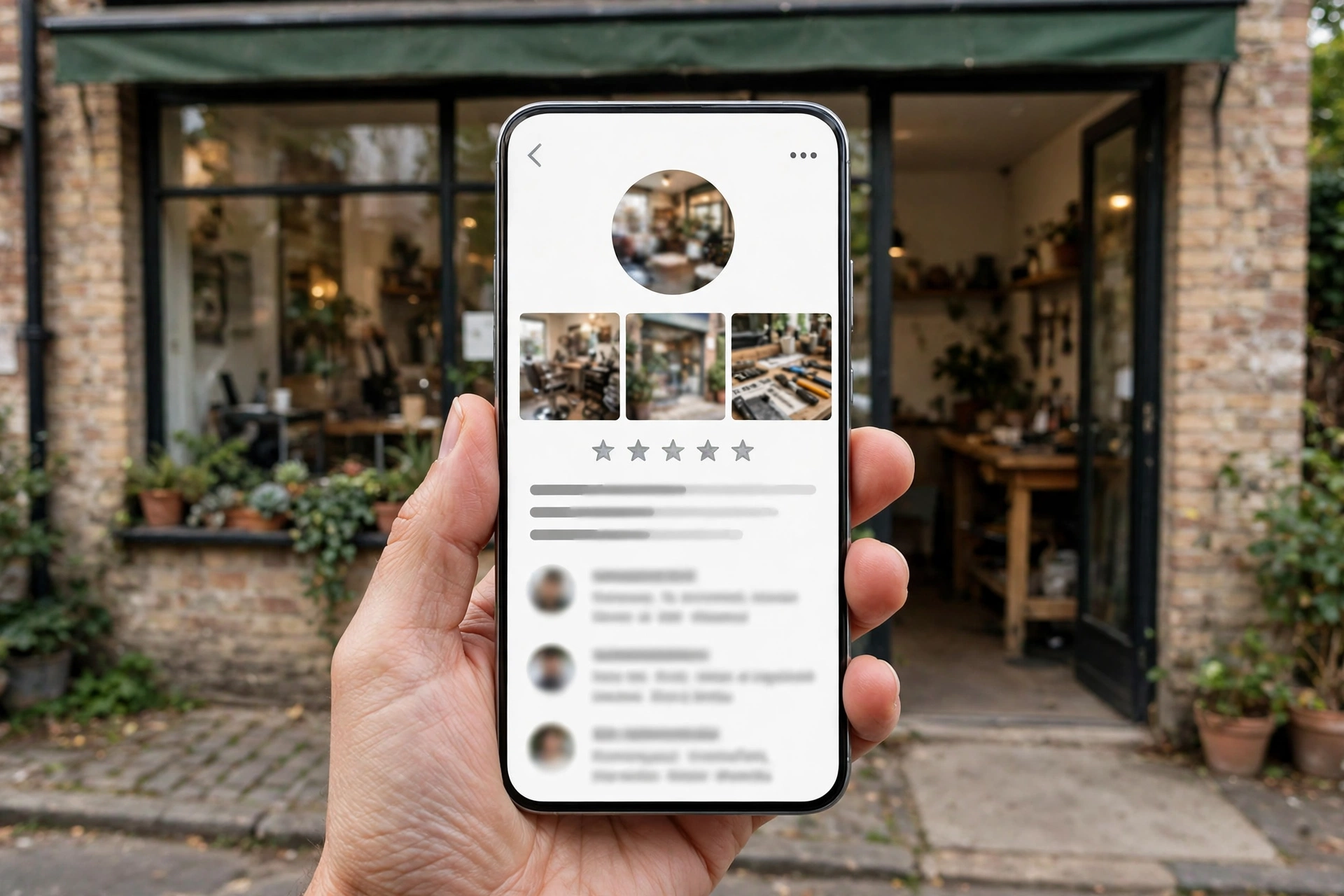
Your Google Business Profile is often the first thing a customer sees, and for many local searches, it is more important than your website ranking alone. A franchise location profile can look strong in total, but a well-managed independent profile can look stronger in your town.
Keep your profile accurate and complete. Check your business name, categories, services, hours, and service area. Add photos from real jobs, not stock photos. Post updates regularly, about jobs, seasonal needs, and common questions. Respond to every review, positive or not, in a personal, helpful tone. Ask for a review after every completed job, while the customer is still happy and the job is fresh in their mind.
Do this every week, not once and then never again. Google and customers both notice recency. A profile with recent photos, recent posts, and recent reviews looks active and trustworthy. A profile that has not been updated in months looks neglected, even if the business itself is excellent.
This is not glamorous work, but it is the work that wins local calls. Many businesses, including franchises, neglect it at the local level. That is your opening.
Step four: collect reviews like a system, not a favour
Reviews are not just nice to have. They are a ranking signal, a trust signal, and a conversion signal, all at once. A customer who sees recent, local, detailed reviews is more likely to call you than a competitor with older, generic reviews.
Build a simple system. After every job, send a short, polite request with a direct link to your review page. Make it easy. Do not ask for a review weeks later, when the customer has forgotten the details. Do not offer incentives that break platform rules. Do ask at the right moment, when the job is complete and the customer is satisfied.
When reviews come in, respond to each one. Thank customers by name where appropriate, mention the service or town if relevant, and address any concern calmly and professionally. Potential customers read responses, and they judge how you will treat them by how you treat reviewers.
Over time, this system compounds. Each new review makes the next customer more likely to choose you, and makes Google more likely to show you. A franchise may have more reviews in total nationally, but you can have more recent, relevant reviews in your town. That is what matters for a local search.
Step five: answer the exact questions customers ask
Franchise websites often answer general questions. You can answer specific questions, in the words customers actually use, and that is a powerful SEO advantage.
Listen to your phone calls, your messages, and your job conversations. Write down the questions you hear repeatedly. For dumpster rental, those questions might be about sizes, what can go in a dumpster, how long you can keep it, and what happens if it rains or if the driveway is narrow. For garage door repair, they might be about a door that will not open, a broken spring, a noisy opener, or a door that is off track. For junk removal, they might be about what items you take, how pricing works, how fast you can come, and whether you donate or recycle.
Turn each question into a clear section, a blog post, or a FAQ on the relevant service page. Answer directly first, then explain in more detail. Use plain language. Do not hide the answer behind a long introduction. Customers and AI search tools both reward direct, useful answers.
This approach also helps with AI search. When a customer asks a voice assistant or an AI tool for help, that tool looks for a clear, direct answer from a trustworthy source. A specific, well-written answer on your site is more likely to be quoted than a generic franchise page.
Dumpster rental: how an indie beats a franchise
Dumpster rental demand follows construction, remodels, roofing, and cleanouts, and it is highly local. A customer needs a dumpster delivered to a specific address, on a specific day, at a clear price. That local, practical need is your advantage.
Focus on the metros and suburbs where construction and renovation are active, and where you can deliver reliably. Build pages for residential, construction, and roofing dumpsters separately, because customers search for those jobs differently. Explain sizes in plain terms, explain what can and cannot go in a dumpster, and explain delivery and pickup clearly.
Collect reviews from homeowners and contractors in the towns you serve, and show photos of real deliveries. A franchise page that lists many cities but shows no local delivery proof is weaker, for a local customer, than your page that shows real work in their town.
Do not try to rank nationally for dumpster rental. Rank for dumpster rental in the towns you serve, for the jobs you do best, and let that focus compound.
Garage door repair: how an indie beats a franchise
Garage door repair is an emergency business. When a spring breaks or a door will not open, the customer does not browse for hours. They search, they call the first trusted business they see, and they book the same day. Speed, availability, and trust matter more than brand size.
Focus on emergency intent. Build pages for spring repair, opener repair, cable repair, and off-track doors separately, because customers search for the problem, not for a generic company name. Make it clear that you offer same-day or emergency service where you do, and make your phone number easy to find and tap on a phone.
Target towns with older housing, where doors, springs, and openers have been in use for decades and fail more often, as well as growing suburbs where new doors and smart openers create replacement work. Explain the problem, the fix, and what to expect, in plain language, without technical jargon.
Reviews matter especially here, because a customer is inviting a technician into their home, often urgently. Recent, local reviews that mention fast response, clear pricing, and a fixed door on the first visit are powerful. A franchise may have a national reputation, but your local reviews can be more convincing for a customer in your town.
Our garage door repair SEO services are built around this emergency-first approach, and the same principles apply to your own local pages.
Junk removal: how an indie beats a franchise
Junk removal is a route-density and trust business. Customers want a crew that arrives on time, gives a clear price, works quickly and cleanly, and leaves the space clear. They also want to know what happens to their items, whether they are donated, recycled, or disposed of properly.
Focus on the towns where you can build dense routes, rather than trying to cover a huge area thinly. Build pages for furniture removal, appliance removal, estate cleanouts, and construction debris separately, because those jobs have different customers, different pricing, and different questions.
Collect reviews that mention speed, cleanliness, and fair pricing, and show before-and-after photos where you have permission. Those details matter more to a customer than a national brand name, because they describe the exact experience the customer will have.
Be careful about paid search in large, saturated metros, where large franchises and many local competitors can make paid leads expensive. Organic local SEO, with strong reviews and service pages, can be a more sustainable path for an independent junk removal company, especially in winnable metros where you can build density first and expand later.
Our junk removal SEO services follow that approach, starting with winnable markets and expanding town by town.
What not to do when competing with a franchise
Do not copy a franchise website, copy its pages, or use its brand name in your content to try to capture its traffic. That can create legal and trust problems, and it does not build your own authority.
Do not buy large numbers of low-quality links, create fake reviews, or create thin pages for towns you do not serve. Those tactics can harm your rankings and reputation, and are difficult to undo.
Do not try to rank for everything at once. Focus is your advantage. A narrow, deep plan that you execute consistently will beat a broad, shallow plan that you abandon after a few weeks.
Do not ignore your existing customers. Repeat work, referrals, and reviews from happy customers are the cheapest and most trustworthy growth you have. An agency or a plan that only focuses on new traffic, and ignores retention and reviews, is missing half the opportunity.
A simple weekly indie playbook
If you want a routine you can actually follow, use this one. It is simple, and consistency matters more than complexity.
Each week, do one local visibility task, ask for reviews after every job, and publish or improve one page that answers a real customer question. Each month, review which pages and towns are bringing jobs, and which town should be next.
That routine, repeated for months, is how independent businesses outrank franchises in their area. It is not about one big campaign. It is about many small, local, trustworthy signals, built up over time.
For help turning that routine into a full plan, read SEO Pricing in the USA: What $790, $1,690, and $3,290 Per Month Should Actually Buy You, which explains what each tier should include, and From Click to Call: How to Write a Homepage That Converts Local Search Traffic, which shows how to turn the traffic you win into calls. For the longer timeline, read Organic SEO Growth Guide USA: The 90-Day Plan for Dumpster, Garage, and Junk Removal Companies.
Frequently asked questions
FAQ
Get a plan to beat the franchise in your town
If you want to know where you stand against the franchise in your area, and what it would take to outrank it for your core services and towns, start with an audit. We will look at your profile, your reviews, your pages, and your local competition, and show you a focused plan.
Request your free audit and tell us your services and service area. We will show you the towns and services to prioritise first, and the weekly routine that will help you win them.
Tags
- #beat franchise local search
- #indie vs franchise seo
- #local seo vs franchise
- #small business vs franchise google